Current WMS
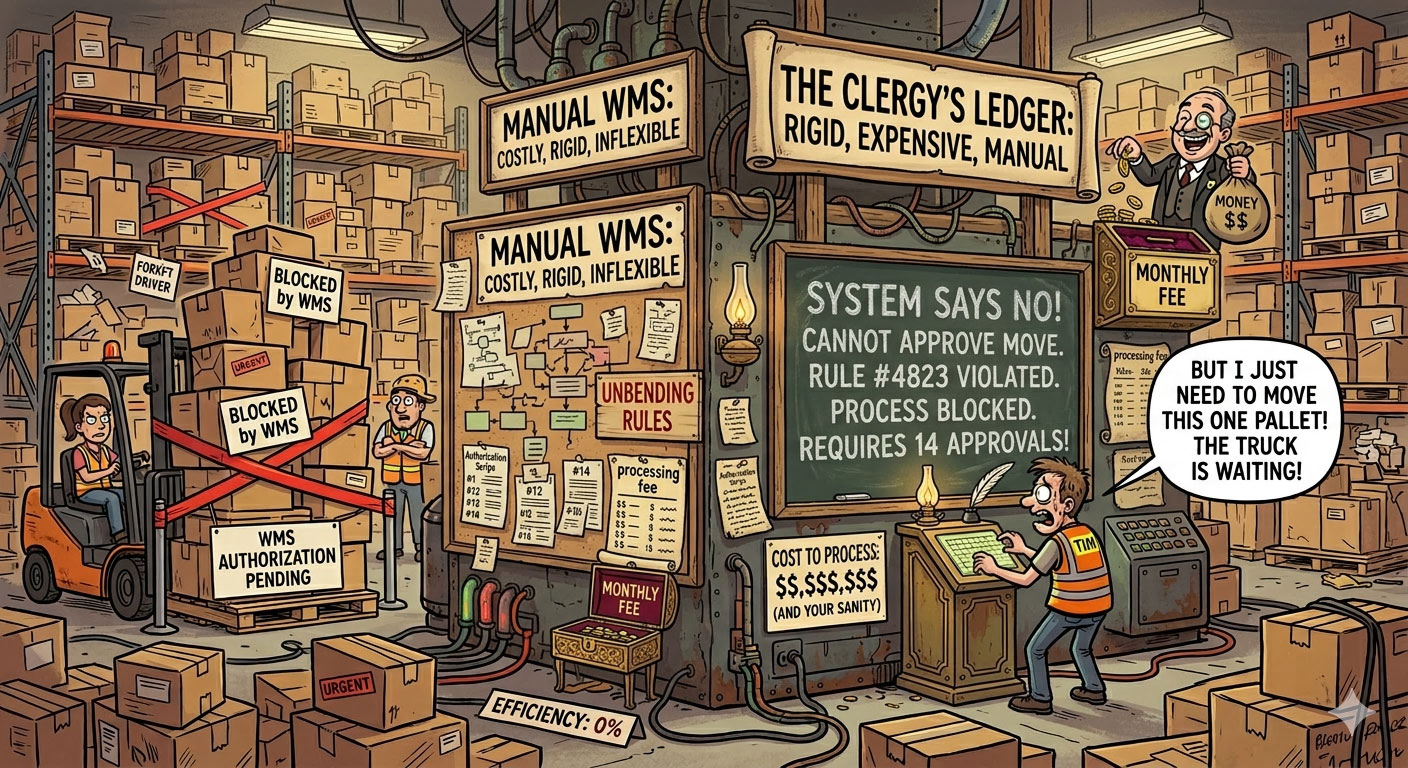
Current Warehouse Management Systems were revolutionary when they shifted operations from paper to digital and from manual registration to digital scanning.
“They were never built to handle today’s and future complexities of in-motion tasks and hyper-automation.”
Below are some of the core limitations that prevent current Warehouse Management Systems from meeting future demands.
Static Queue-Based Logic Gap
Assignment of users to resource groups associated with specific work queues. Current systems can’t handle tasks appearing outside their assigned queue; such issues must be resolved by a human manually intervening.
Batch Processing
Processing data in batches, “Waves.” Wave management is a manual procedure handled by the wave planner, who groups orders and releases them to shopfloor operators.
Automation Capabilities
Current Warehouse Management Systems were built to manage human labor. If you need to add Autonomous Mobile Robots (AMRs) or automated picking arms, you have to install additional systems.
Predictive Intelligence
Current warehouse management systems lack predictive and prescriptive capabilities to control the in-motion positions of resources, preventing errors and KPI failures.
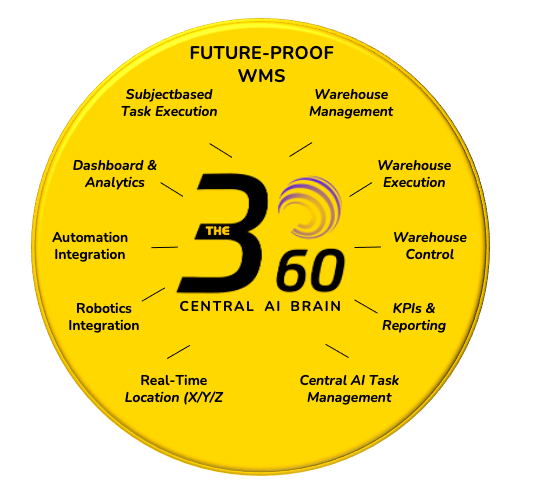
“Future-Proof WMS”
Future-proof warehouse management is subject-driven, digitalized, and uses a central AI brain to synchronize the in-motion positions of manual and automated resources, intelligently distributing cross-functional tasks.
- The future WMS treats in-motion resources as free-roaming, intelligent, cross-functional assets. It uses holistic in-motion positioning technology (X/Y/Z) to select optimal resources and orchestrate rule-based tasks.
- The subject-driven WMS central AI brain maintains a pool of tasks and automatically “pushes” tasks to the resources (the Subjects).
The central AI brain comprehensively considers manual and automated resources, their skill sets and capacities, dependencies, priorities, and escalations before distributing the optimal task to the selected resource, interoperability, and hyperautomation.